By clicking “Accept”, you agree to the storing of cookies on your device to enhance site navigation, analyze site usage, and assist in our marketing efforts. View our Privacy Policy for more information.
Cyber Security and Resilience Bill: What It Means for Your Supply Chain
Where the Cyber Security and Resilience Bill stands, a one-table summary, the critical supplier designation test and a 30-day supplier evidence review.
Risk Ledger
|
Company
October 16, 2026
|
25
mins read
Share
Last updated 16 October 2026: rewritten with the current Parliamentary stage, a one-table summary of the Bill, the critical supplier designation test, a guide to the government factsheets and a 30-day supplier evidence review.
Quick answer
The Cyber Security and Resilience Bill is proposed UK legislation that updates the NIS Regulations 2018 by extending cyber security duties beyond essential service operators to the managed service providers, data centres and critical suppliers they depend on.
The Bill is still going through Parliament and is not yet law.
It brings managed service providers, data centres and large load controllers into UK cyber regulation.
Regulators will be able to designate critical suppliers to essential and digital services and hold them to security duties.
More harmful incidents must be reported, with an initial notice within 24 hours and a fuller report within 72 hours.
Most measures take effect through secondary legislation after Royal Assent, so the detailed duties are still to come.
Can we demonstrate we have taken appropriate steps to manage supplier risk? Auditors, regulators and boards all ask some version of it after a supplier incident, and it's often harder to answer than it should be.
Most supplier checks happen once, at onboarding, and the evidence starts ageing the day the contract is signed. In public sector audits and Cyber Assessment Framework (CAF) reviews, security teams describe supply chain as “always a big gap”.
The Cyber Security and Resilience Bill makes that question harder to avoid. It is still going through Parliament, but it extends UK cyber regulation to managed service providers, data centres and suppliers that regulators judge critical.
If you run essential services, your regulatory position changes. If you rely on suppliers in those categories, what you can expect from them changes too.
Network and information systems are the computers, networks, software and data an organisation depends on to keep a service running. In the government’s own example, an NHS hospital’s systems include patient records, diagnostic tools, staff scheduling software and connected medical devices.
The government groups the Bill’s reforms into three parts:
Expanded scope. Data centres, managed service providers and large load controllers come into the regime, and regulators gain a power to designate critical suppliers to essential and digital services.
Faster government response. Ministers can add sectors or update security requirements through secondary legislation. They can also direct regulators or regulated organisations to act when there is a threat to national security.
For most security teams, expanded scope matters most, because it reaches into the supply chain rather than stopping at the operator.
The Bill does not regulate the whole economy. The government is explicit that the regime covers services whose disruption would affect daily life. Much of the operational detail, including what designated suppliers must do, arrives in secondary legislation after Royal Assent.
No. The EU Cyber Resilience Act (Regulation (EU) 2024/2847) is an EU product security law covering products with digital elements sold in the EU.
Its reporting obligations for manufacturers have applied since 11 September 2026, and most of its requirements apply from 11 December 2027.
The UK Bill regulates services and the organisations that run them, while the Cyber Resilience Act regulates products. A UK manufacturer selling into the EU may need to consider both.
Cyber Security and Resilience Bill summary: the main measures at a glance
The Cyber Security and Resilience Bill makes eleven changes to UK cyber regulation. Four widen who is regulated, five change how regulators oversee and enforce, and two give government new powers to act. Three take effect within two months of Royal Assent. The other eight, including critical supplier designation and faster incident reporting, wait for secondary legislation.
At a glance
The Cyber Security and Resilience Bill in eleven measures
What each measure changes, who it affects and when it starts after Royal Assent.
Data centres become an essential service in a new data infrastructure sector. Medium, large and enterprise data centres that meet the thresholds must manage risks, with Ofcom as regulator.
Data centre operators and the organisations that rely on them
Medium and large managed service providers come into scope with security duties, regulated by the ICO. Rules for digital service providers are updated at the same time.
IT and security service providers, and their customers
Regulators can designate suppliers whose disruption could significantly affect essential or digital services. Their duties will be set later and will be no stricter than those on regulated operators.
More harmful incidents become reportable, with an initial notice within 24 hours and a fuller report within 72 hours. The NCSC is told at the same time, and data centres and digital and managed service providers must tell customers likely to be affected.
All regulated organisations, and customers of in-scope providers
Two penalty bands replace three. The maximum is £17 million or 4% of worldwide turnover for more serious breaches, and £10 million or 2% for less serious ones, whichever is higher.
Government can direct regulators or regulated organisations to take targeted action in response to threats to national security.
Regulators and regulated organisations
Secondary legislation
Start dates are measured from Royal Assent. Source: government factsheets, updated 30 June 2026. The government describes its list of start dates as non-exhaustive.
Timing is where most readers misread the Bill. Royal Assent will not switch on the duties that matter most for supplier risk. Critical supplier designation, the new rules for managed service providers and data centres, faster incident reporting and the higher penalties all depend on secondary legislation. The government intends to consult on implementation in 2026, and has committed to communicating a business adjustment period before new or updated duties come into force.
Only three measures start within two months of Royal Assent, and none of them places a new duty on a supplier. That gives security teams time, but not a reason to wait.
The direction is set in the Bill. The evidence regulators and auditors will ask for, such as which suppliers support which services and how each has been assessed since the contract was signed, is easier to build before a deadline exists than after one.
Which rows matter most depends on where you sit:
Already regulated under NIS. The incident reporting, enforcement and cost recovery rows change your own obligations, including the fees you will pay your regulator.
Relying on suppliers in scope. The managed service provider, data centre and designation rows matter more. They change what those suppliers must do, and the new customer notification duty means you should hear sooner when a provider’s incident is likely to affect you.
The penalty figures are maximums. The government says its goal is a culture of compliance rather than widespread fines. When setting a penalty, regulators must weigh factors such as an organisation’s attempts at mitigation and its history of non-compliance, and penalties can be appealed to the First-tier Tribunal. How turnover is calculated will also be set in secondary legislation.
Has the Cyber Security and Resilience Bill been passed? Status and timeline
No. As at 16 October 2026, the Cyber Security and Resilience Bill has completed all its House of Commons stages and is in the House of Lords. Lords Report stage is listed for 26 October 2026. The Bill becomes law at Royal Assent, but most of its duties then wait for secondary legislation.
Some measures on Day 1 and in Month 2. Most follow through secondary legislation after consultation.
Dates link to the relevant stage on bills.parliament.uk or gov.uk. This timeline is updated at each Parliamentary milestone.
The Bill has already been carried over from one session of Parliament to the next. A carry-over motion lets a bill continue into the next session rather than starting again, and the Commons agreed one on 6 January 2026. The Bill was reintroduced on 14 May 2026, completed its Commons Report stage and third reading on 16 June, and moved to the Lords the next day.
In the Lords, second reading took place on 14 July and committee stage began on 1 September. Report stage is listed for 26 October 2026, although Parliament notes that future dates can be provisional. Lords third reading follows. If the Lords have changed the text, both Houses then have to agree the final wording. Only after that does the Bill receive Royal Assent and become an Act, and no date has been set for it yet.
Amendments are still possible, so details can change before Royal Assent. The government has already updated several of its factsheets twice in 2026. The March update reflected the Commons committee debates, and the June update made clarifications for legal reasons.
What happens after Royal Assent?
Royal Assent starts a phased rollout rather than switching everything on at once. The government’s sequence has three stages:
Day 1. The future-proofing powers and the post-implementation review.
Month 2. The statement of strategic priorities and the information sharing rules.
Later, through commencement regulations. These cover data centres, managed and digital service providers, large load controllers, critical suppliers, incident reporting, cost recovery and powers of direction. The enforcement changes also come in this way.
The government plans to consult on implementation in 2026 and publish its response, then lay the secondary legislation. Organisations get an adjustment period before new duties apply.
Managed service providers, digital service providers and data centres will have set timeframes to register with their regulator once their provisions are in force. Registration is a practical milestone to watch. Once it opens, you can reasonably ask your managed service, cloud and data centre providers to confirm whether they are in scope.
Who is in scope of the Cyber Security and Resilience Bill?
The Cyber Security and Resilience Bill covers two groups:
Already regulated under NIS, and staying in scope. Operators of essential services in energy, transport, health, drinking water and digital infrastructure, plus medium and large digital service providers.
Joining the regime. Managed service providers, data centres, large load controllers and suppliers that regulators designate as critical.
Scope
Who the Bill covers
Two categories already regulated under NIS, and four that join the regime.
ExamplesNHS trusts, integrated care boards and relevant independent providers; electricity, oil and gas; air, rail, maritime and road; drinking water; digital infrastructure
Threshold or testSector-specific thresholds in the NIS Regulations 2018
ExamplesIT outsourcing, helpdesks, application and infrastructure management, and managed security such as SOC and SIEM services
Threshold or testOngoing management of a customer's IT through access to its systems. Small and micro providers are excluded, as are publicly overseen bodies earning less than half their income commercially.
ExamplesAny supplier that meets the conditions, including small and micro managed service providers
Threshold or testFour statutory conditions and a regulator's designation decision. Public sector bodies are intended to be excluded.
RegulatorThe regulator of the organisation the supplier serves
Practical test
If a supplier connects to your systems to manage them on an ongoing basis and is not a small or micro business, treat it as a likely managed service provider under the Bill. Ask it now whether it expects to register with the Information Commission.
Scope depends on the service provided, not the sector label. Source: government factsheets, updated 30 June 2026.
Scope depends on the service an organisation provides, not its sector label. Drinking water supply is in scope, but wastewater sits only under economy-wide guidance. Most telecoms providers fall under the Telecommunications (Security) Act 2021 rather than NIS.
The new managed service provider category also has clear edges. The government’s own examples place an IT company that monitors and manages a customer’s network in scope. Three kinds of provider are out of scope: a software company selling a product with occasional remote patches, an installer that walks away after go-live, and a provider of operational technology with no ongoing IT management.
Where a provider is based does not decide whether it is in scope. Managed service providers are covered if they provide managed services in the UK, whether or not they are established here, and overseas providers must appoint a UK representative. For supplier assurance, that matters: a US-headquartered managed service provider supporting your UK estate is treated the same as a UK one.
Where does your organisation sit?
Most organisations reading this sit in one of three positions, and many sit in two:
Directly regulated. NHS trusts, integrated care boards, and energy, transport, drinking water and digital infrastructure operators are already operators of essential services. For them, the Bill tightens existing duties.
Outside direct scope, but relying on suppliers who are in it. This covers most local councils, central government departments, police forces, and financial services and insurance firms. For them, the Bill changes what their managed service, cloud and data centre providers must do. Financial services firms continue to work under the Financial Services and Markets Act 2023.
A supplier who could be regulated or designated. The supplier sections below cover this position.
The positions overlap in practice. An NHS trust is regulated directly, but it also depends on managed service providers that may soon be regulated in their own right, and on specialist suppliers such as pathology providers that a regulator could designate. Its assurance work runs in both directions at once.
Public bodies also have two specific carve-outs. The government intends to exclude public sector organisations from designation as critical suppliers, subject to consultation. A public body providing IT services to other public bodies is also excluded from the managed service provider category, provided it is under public authority oversight and earns less than half its income commercially.
One rule cuts the other way. Data centres run by or for the Crown are within the new regime, apart from national security exemptions. A government body operating its own data centre at 10MW or more of rated IT load can therefore be in scope directly. Most public bodies won’t meet that threshold, but it’s worth checking before assuming you’re outside the Bill.
What does the Bill change in the NIS Regulations 2018?
The Cyber Security and Resilience Bill changes the NIS Regulations 2018 in four ways:
who is covered
which incidents must be reported, and how fast
who has to be told when something goes wrong
how penalties are set
Existing operators feel the change mainly through reporting and enforcement. Managed service providers, data centres, large load controllers and designated suppliers feel it through scope.
Before and after
What changes from the NIS Regulations 2018
Six changes, comparing today's rules with what the Bill proposes.
AreaUnder NIS 2018Under the Bill
Who is covered
Under NIS 2018Operators of essential services in five sectors, plus relevant digital service providers.
Under the BillAdds managed service providers, data centres, large load controllers and designated critical suppliers.
Supplier oversight
Under NIS 2018Suppliers are not regulated directly. Operators manage supplier risk through their own duties.
Under the BillRegulators can designate critical suppliers and oversee them directly.
What must be reported
Under NIS 2018Incidents that disrupt the service. An attacker positioned to disrupt is not reportable until disruption happens.
Under the BillIncidents affecting the operation or security of systems with a significant actual or likely impact, including ransomware and pre-positioning.
Reporting timeline
Under NIS 2018Report to the regulator within 72 hours. The regulator then tells the NCSC.
Under the BillInitial notice within 24 hours to the regulator and NCSC together, then a full report within 72 hours.
Telling customers
Under NIS 2018No duty to tell customers they may have been affected.
Under the BillData centres and managed and digital service providers must notify customers likely to be affected, after their full report.
Penalties
Under NIS 2018Three bands, with a maximum of £17 million.
Under the BillTwo bands: up to £17 million or 4% of worldwide turnover, and up to £10 million or 2%, whichever is higher.
Practical test
Pick your most critical service and ask whether you could name, within 72 hours, every supplier whose incident could take it down. If you can't, that is the first piece of supplier evidence to build.
The biggest practical change is when an incident becomes reportable. Under the current rules, an attacker who has broken in and is positioned to disrupt a service only becomes reportable once the disruption happens. The Bill moves that point earlier, to when an incident has, or is likely to have, a significant impact.
Incident reporting: 24 hours, then 72 hours
Operators of essential services, digital service providers, managed service providers and data centres report to their regulator, and the NCSC is told at the same time. The report comes in two stages:
The initial notice, within 24 hours of becoming aware of an incident. It needs only the organisation’s name, the affected service and brief details.
In the government’s own example, an NHS trust hit by a major attack notifies the Department of Health and Social Care and the NCSC within 24 hours, then files the full report at 72 hours.
That question about other regulated organisations is where incident reporting meets supplier assurance. If a managed service provider or data centre causes your incident, your full report has to say so, which means you need to know quickly which supplier sits behind the affected service.
The Bill helps with that from the other direction. Data centres, managed service providers and digital service providers must tell customers likely to have been affected, with details of the incident and why they think you were affected. That duty applies only after the provider has filed its own full report, so it won’t arrive in the first hours of an incident. The contractual notification clauses you already rely on still matter.
The thresholds for what counts as “significant” will be set in secondary legislation after consultation. Until then, the rule applies to regulated organisations and significant incidents only. It is not a requirement to report every security event within 24 hours.
Who enforces it and what are the penalties?
Enforcement stays with the NIS regulators, of which there are now 12 across sectors. The Bill adds:
the Information Commission for managed and digital service providers
The higher band. Breaches of incident notification and security duties, up to £17 million or 4% of worldwide turnover, whichever is higher.
The standard band. Lesser breaches, such as a provider failing to register, up to £10 million or 2%.
Regulators issue a notice before any final penalty, and organisations can make representations and appeal to the First-tier Tribunal. Steps taken to fix a problem count in the organisation’s favour, and not every breach leads to a fine.
What does the Bill mean for your suppliers and third parties?
The Cyber Security and Resilience Bill brings parts of the supply chain under direct regulation for the first time. Medium and large managed service providers and qualifying data centres become regulated, and regulators can designate other suppliers as critical. Organisations that depend on those suppliers still carry responsibility for managing the risk they bring.
What that means depends on where you sit:
If you’re already regulated. Your existing duty to manage risks to the systems your service relies on still covers your suppliers. The Bill adds a second line of oversight, because some of those suppliers will now answer to a regulator of their own. That gives you more information about them. It doesn’t reduce what your own regulator expects you to show about how you manage them.
If you rely on in-scope suppliers but aren’t regulated yourself. You gain better signals, mainly registration with a regulator and a duty to tell you about incidents likely to affect you. A supplier being regulated still isn’t the same as a supplier being assured for the way you use it.
Two incidents show why the Bill reaches into the supply chain, and they fail in different ways.
MOVEit Transfer: one product, many organisations. From 27 May 2023, the CL0P ransomware group exploited a previously unknown vulnerability in MOVEit Transfer, a file transfer product used by organisations and their suppliers. It stole data from many of them through the same flaw.
Synnovis: one specialist supplier, no knock-on chain needed. The 2024 ransomware attack on the pathology provider to London NHS trusts disrupted more than 11,000 appointments and operations and caused estimated losses of £32.7 million. The government also links the attack to the death of a patient.
Designated critical suppliers: could one of yours be designated?
Designation is a regulator’s formal decision that a supplier matters so much to regulated services that it should carry security duties of its own. A regulator can designate a supplier only if all four of these are true:
It supplies goods or services directly to an operator of essential services, a digital service provider or a managed service provider.
It relies on network and information systems to deliver that supply.
An incident affecting it could disrupt the services it supports.
That disruption would have a significant impact on the economy or on day-to-day life.
Regulators must also consider whether the service could realistically come from somewhere else. The government’s own data centre evidence shows the pattern. Just ten operators generate 80% of UK data centre revenue and control two-thirds of live capacity.
Designation follows a process. The regulator consults the supplier first, and the supplier can appeal to the First-tier Tribunal. Size alone doesn’t protect a supplier, since small and micro managed service providers can be designated. Public sector bodies are intended to be excluded. A designated supplier’s duties will be set in secondary legislation, and they won’t be stricter than those on the operators it supplies.
Designation is also a limited tool. Regulators decide it, not you, and it is meant for suppliers whose failure would be felt nationally. Your own list of critical suppliers should be longer than any regulator’s, because it reflects what would stop your services, not the country’s.
Worked example: tiering suppliers by service criticality, not contract value
In our conversations with public sector security teams, one problem comes up again and again: most digital procurement happens outside the security team’s remit. One security lead put it at “two thirds of digital procurement”, which leaves tiering to follow contract value by default.
Contract value is a poor proxy for risk. The example below shows the alternative. It is illustrative, not drawn from a named organisation, and it uses the same logic regulators apply to designation: impact, dependency on systems, and whether the service could come from somewhere else.
Worked exampleIllustrative, not a real organisation
Tiering by service criticality, not contract value
Five suppliers to the same organisation, tiered by what happens to its services if each one fails.
1Map essential services
2List suppliers behind each
3Flag MSP, cloud and data centre dependencies
4Tier by impact and substitutability
5Set assessment depth
6Set monitoring after contract
Managed IT provider with admin access
Tier 1
WhyManages the systems behind frontline services and could be a regulated managed service provider. One compromise reaches everything it administers.
Assessment depthFull assessment with supporting evidence
After contractOngoing monitoring, with review on any change
Specialist service provider
Tier 1
WhyLow contract value, but delivers a service nobody else could take over quickly. This is the profile regulators weigh for designation.
Assessment depthFull assessment, focused on continuity and recovery
After contractOngoing monitoring, plus a tested contingency plan
Cloud and data centre hosting
Tier 2
WhyHosts several services and may be in scope of the Bill. It may also be shared with many other organisations, which makes it a concentration point.
Assessment depthTargeted assessment, reusing certifications where they cover your use
After contractPeriodic reassessment and incident alerts
Small community service partner
Tier 3
WhyHandles limited data and has no system access. A full questionnaire would be disproportionate.
Assessment depthA short, light-touch set of questions
After contractReview at renewal
High-value facilities contract
Tier 3
WhyOne of the largest contracts by value, but no access to systems or sensitive data, and nothing critical stops if it fails.
Assessment depthA short, light-touch set of questions
After contractReview at renewal
Practical decision rule
Tier by asking what stops if a supplier fails and how quickly it could be replaced. Use contract value only to break ties.
Two rows in the example tend to surprise people. The high-value facilities contract drops to the lowest tier because nothing critical breaks if it fails. The small specialist provider moves up because nothing could replace it quickly. Proportionate depth also matters at the bottom of the list. Small suppliers sent a full questionnaire are often, in one security lead’s words, “overawed by the sheer number of questions”.
Why a one-off check at contract signature won’t hold up
The pattern we hear most often from security teams is a programme that is strong up to signature and then stops. In one buyer’s words: “it was really strong up until they signed the contract. And then we just walked away and forgot about it completely.”
I heard one CISO once refer to third-party risk as a paper shield. He knew he had to do it. He was regulated, so he did it for the regulation, but he knew it wasn't actually offering him any kind of protection beyond a bit of paper that he had in that supplier if something were to go wrong.
Haydn BrooksCEO and co-founder, Risk Ledger
The Bill makes that gap harder to carry. A full incident report has to say whether a supplier’s incident caused yours, within 72 hours. That depends on knowing today which suppliers sit behind which services, and how they’ve changed since onboarding.
In practice, that means keeping assurance current for the suppliers already onboarded. Review them by exception when something changes, not on a fixed annual cycle alone. As one buyer put it, assurance is “not just a sort of driving licence type scenario”.
Reusing an assessment another organisation has already carried out can save you and your supplier time, but it supports your judgement rather than replacing it. Your organisation still owns the risk. Buyers have also been clear that they want evidence, not “a better questionnaire”. Questionnaires still have a place. What causes trouble is collecting the same answers repeatedly and letting them go stale.
What the Cyber Security and Resilience Bill factsheets cover
The government has published 14 factsheets on the Cyber Security and Resilience Bill: a summary, plus one for each main measure. They were last updated on 30 June 2026. They explain the policy intent in plain English, with worked examples. They are policy papers, though, so the Bill and later secondary legislation take precedence.
Factsheet guide
Which factsheets to read, in order
Pick the path that matches where your organisation sits.
All 14 factsheets are on the gov.uk collection page, last updated 30 June 2026. They set out policy intent. The Bill and secondary legislation take precedence.
The 14 factsheets fall into three groups:
Scope. Data centres, managed service providers, digital service providers, large load controllers and designating critical suppliers.
How regulators work. Incident reporting, the statement of strategic priorities, information sharing, cost recovery and enforcement.
Government powers. Future-proofing, the power to direct regulated organisations and the power to direct regulators.
The summary ties them together and sets out when each measure starts.
For supplier assurance, four factsheets carry most of the useful detail:
Managed service providers: Real examples of providers that are in and out of scope, which you can test your own suppliers against.
Incident reporting: What a 72-hour report must contain, including whether another organisation’s incident caused yours, and when providers must tell their customers.
Data centres: The clearest public sector example in the set. In July 2022, two data centres serving an NHS trust failed during a heatwave. Most clinical IT went down at three hospitals, and the trust spent £1.4 million in unplanned technology costs responding.
The factsheets change as the Bill moves through Parliament. They were first published on 12 November 2025, amended on 6 March 2026 after the Commons committee debates, and amended again on 30 June 2026 for clarity and legal accuracy. Each one shows its own “Updated” date at the top, and the collection page offers email alerts when anything changes.
The factsheets don’t contain the detail most teams are waiting for. That includes the thresholds for a “significant” incident, how turnover is calculated for penalties, and what duties a designated supplier will carry. All three arrive through secondary legislation after consultation. For more detail now, Parliament’s Bill page also publishes the explanatory notes, the delegated powers memorandum and the impact assessments.
Which NCSC guidance applies to the Cyber Security and Resilience Bill?
The main NCSC guidance for the Cyber Security and Resilience Bill is the Cyber Assessment Framework (CAF). It is the outcome-based framework that nearly all UK cyber regulators use to assess organisations running essential services. Version 4.0, published in August 2025, covers supply chain under principle A4.
The Bill and the CAF do different jobs:
The Bill sets the duties: These are to manage risk, report incidents and co-operate with the regulator.
The CAF describes what meeting those duties looks like: It sets out outcomes rather than prescribing controls.
The NCSC developed version 4.0 in consultation with the cyber regulators that use it, and it is established in the public sector through GovAssure. For most regulated organisations and central government bodies, the CAF is the framework their supplier evidence will be judged against.
A4.a, Supply chain. You understand and effectively manage the risks suppliers pose to the systems behind your essential functions.
A4.b, Secure software development and support. You maximise the use of secure, supported software, whether built in-house or bought in.
CAF 4.0, principle A4.a
What each CAF level looks like for supply chain
Selected indicators from the NCSC's A4.a supply chain outcome, and why each matters under the Bill.
Level 1Not achieved
Any one of these is true
Little or no visibility of subcontractors in the supply chain
No clear view of which contracts are relevant, or relevant contracts lack security obligations
Supplier access to key systems is unrestricted, unmonitored or bypasses your controls
Why it matters under the Bill
You could not say within 72 hours whether a supplier caused an incident.
Level 2Partially achieved
Realistic first target
All of these are true
You know the extent of the supply chain behind your essential functions, including subcontractors
Suppliers can show proportionate security against common threats
You know all third-party connections and have assurance they meet your requirements
Incident management considers incidents arising in your supply chain
Why it matters under the Bill
You can trace an incident to the supplier behind it and report it accurately.
Level 3Achieved
All of these are true
Deep understanding of the supply chain, including subcontractors and the wider risks it faces
Supplier ownership, nationality and partnerships inform procurement decisions
Critical suppliers can show security proportionate to capable, well-resourced attackers
You and your suppliers support each other in resolving incidents
Why it matters under the Bill
You can see concentration and designation risk before a regulator or incident points it out.
Indicators summarised from NCSC CAF principle A4, version 4.0. The CAF is outcome-based, so these are indicators, not a checklist.
The CAF states accountability as plainly as the Bill does. If you rely on third parties, such as outsourced or cloud services, you remain accountable for protecting the essential function.
The “achieved” level also reads like a description of the Bill’s supply chain expectations:
a deep understanding of your supply chain, including subcontractors
factors such as a supplier’s ownership and nationality feeding into procurement decisions
critical suppliers able to show security proportionate to capable, well-resourced attackers
proactive contract management
incident management in which you and your suppliers support each other in resolving incidents
That last point maps directly onto the Bill’s 72-hour report, which asks whether another organisation’s incident caused yours.
The CAF is not a checklist. Its indicators describe outcomes, and “achieved” against A4.a asks for more than most programmes collect today. Visibility of subcontractors is where many fall short, because the “not achieved” column includes having little or no visibility of them. For most teams, partially achieved is the realistic first target, and that level already requires knowing the full extent of the supply chain behind your essential functions.
Several other NCSC resources are linked directly from principle A4:
Financial services firms sit outside the NIS sectors, so NIS regulators won’t assess them against the CAF. Their expectations for supplier risk come from their financial regulators, under the Financial Services and Markets Act 2023 framework mentioned earlier.
How does the Cyber Security and Resilience Bill compare with NIS2 and DORA?
The Cyber Security and Resilience Bill updates the UK’s NIS rules. It shares NIS2’s cross-sector scope, supply chain focus and staged incident reporting. DORA is different, because it applies only to EU financial entities and their ICT providers. In the UK, the closest parallel to supplier designation is the financial services critical third parties regime.
Comparison
The Bill alongside NIS2, DORA and the UK critical third parties regime
The same six questions for each regime. A starting point, not legal advice.
Who it applies toEssential service operators in five sectors, digital service providers, and now managed service providers, data centres and large load controllers
Supplier oversightManaged service providers regulated directly. Regulators can designate critical suppliers.
Incident reportingInitial notice within 24 hours, full report within 72 hours
Maximum penalties£17m or 4% of worldwide turnover, or £10m or 2%, whichever is higher
StatusIn Parliament. Most duties follow through secondary legislation.
Who it applies toThird parties designated by HM Treasury as critical to UK financial services
Supplier oversightThe Bank of England, PRA and FCA oversee designated providers directly. Firms keep responsibility for their own suppliers.
Incident reportingDesignated providers notify the financial regulators of major incidents
Maximum penaltiesEnforcement through the regulators' powers under financial services law
StatusRules in force since 1 January 2025. First designated providers overseen from 13 July 2026.
Practical decision rule
Start with the regime that applies to your organisation. Then check which of your suppliers are regulated or designated under the others, because a shared cloud or managed service provider can sit under more than one.
Which regime matters to you depends on where you operate:
UK essential service operators, public bodies and their suppliers: The Cyber Security and Resilience Bill.
UK organisations operating in NIS2 sectors in the EU: NIS2, through each member state’s own law, assessed separately. Our guide to NIS2 covers it in detail.
UK financial services firms: Their own regulators’ rules. Some of their largest providers are now overseen directly under the critical third parties regime, and the Bill reaches them mainly through the managed service, cloud and data centre providers they share with other sectors.
The four regimes have converged on the same two ideas:
Regulators move closer to suppliers that many organisations depend on: The Bill does this through designated critical suppliers, DORA through oversight of critical ICT providers, and the UK regime through critical third parties.
None of them moves accountability off the customer: The FCA says plainly that the critical third parties rules don’t change financial firms’ responsibility for managing their own third-party suppliers. That is the same position the CAF takes for essential services.
The regimes don’t line up neatly. One is a UK Bill, one an EU directive implemented differently in each member state, one an EU regulation that applies directly, and one a UK regime that applies only once HM Treasury designates a provider. Reporting clocks start at different points, and penalties work differently. Use the comparison to see which rules apply to you, then read each regime’s own text.
CSRB compliance: how should security teams prepare?
Start preparing for the Cyber Security and Resilience Bill with the evidence you’d need if a supplier incident happened tomorrow:
Which suppliers support your essential services
How each was assessed
What you’ve checked since the contract was signed
The Bill isn’t law yet, so this is preparation rather than compliance. Most of the work is what the CAF and audit already ask for.
There’s a reason not to wait for the secondary legislation. The duties that will need the most evidence, such as reporting supplier-caused incidents within 72 hours and showing how critical suppliers are managed, depend on records most teams don’t keep today. Building that evidence takes longer than any adjustment period is designed to cover.
The CAF supply chain principle already sets the expectation regulators work from: know the full extent of the supply chain behind your essential functions, including subcontractors. Work done now counts twice, once for CAF, GovAssure or audit this year, and again when the Bill’s duties start.
The first steps depend on where you sit:
If you’re directly regulated. Rehearse the 24-hour and 72-hour reports, including one where a supplier caused the incident. Map your supplier evidence to CAF principle A4.
If you rely on suppliers who are in scope. Ask your managed service, cloud and data centre providers whether they expect to fall within the Bill. Check your contracts give you incident notification and access to evidence. Tier those suppliers first.
If you’re a supplier who may be in scope. Check the managed service provider definition and size test. Plan to register within three months of the duties starting.
A 30-day supplier evidence review
30-day review
A 30-day supplier evidence review
Four weeks to a defensible view of the suppliers behind your essential services, with a minimum version for a team of one.
Week 1Map
Week 2Tier
Week 3Evidence
Week 4Report
WeekFull versionMinimum, team of one
Week1
Map services and suppliers
Full versionList your essential services and the suppliers behind each one. Ask the commercial team for the full contract list.
Minimum, team of oneList only your most critical services and their direct suppliers.
Week2
Tier by service criticality
Full versionTier suppliers by what stops if they fail and how quickly they could be replaced, not by contract value. Flag managed service, cloud and data centre providers that may be in scope.
Minimum, team of oneTier only the suppliers from week 1. Flag managed service, cloud and data centre providers.
Week3
Gather current evidence
Full versionFor top-tier suppliers, record current evidence, the date of the last assessment, known subcontractors and the incident notification terms in the contract. Note anything not checked since signature.
Minimum, team of oneDo this for your top tier only, starting with the last assessment date and incident notification terms.
Week4
Map gaps and report
Full versionMap the gaps to CAF principle A4 and write a one-page summary for your Head of, using the "Take this to your Head of" box.
Minimum, team of oneSame. The one-page summary matters more than complete coverage.
If you’re a team of one, start with the right-hand column. The rest can follow once the top tier is covered.
How to show progress to your Head of
Progress is easier to show with measures than with a narrative. Five measures work for most teams, and none needs a target to be useful at the start:
The share of critical suppliers tiered by service criticality
The share of top-tier suppliers with evidence less than 12 months old
The number of top-tier suppliers reviewed since contract signature
Open findings by tier, and how long they’ve been open
Known subcontractor dependencies behind your top-tier suppliers
The last measure is usually the weakest, and it’s the one CAF principle A4 asks about directly.
Common mistakes to avoid
Common mistakes
Five shortcuts that quietly narrow what you cover
1
Tiering suppliers by contract value
Feels likeAn objective starting point, using data procurement already holds.
Actually missesLow-value specialist suppliers that nothing else could quickly replace, which is exactly the profile regulators weigh for designation.
2
Assessing at procurement, then walking away
Feels likeDue diligence done, with a completed assessment on file.
Actually missesEverything that changes after onboarding, such as new subcontractors, new access and new incidents. It also leaves you unable to say within 72 hours whether a supplier caused yours.
3
Sending micro suppliers the same heavy questionnaire
Feels likeConsistent and fair, because every supplier gets the same treatment.
Actually missesSmall suppliers overwhelmed by the volume give poorer answers, and the effort spent on them is effort not spent on your top tier.
4
Treating a completed questionnaire as validation
Feels likeEvidence on file that the supplier meets your requirements.
Actually missesA questionnaire records what a supplier says. CAF asks critical suppliers to demonstrate their security, so top-tier answers need supporting evidence.
5
Assuming "we're not regulated, so it doesn't apply"
Feels likeA legally accurate reading of the Bill's scope.
Actually missesSuppliers behind your services that may be regulated or designated, Crown data centres that may be in scope, and the audit and GovAssure questions you face either way.
Take this to your Head of
What it is: The Cyber Security and Resilience (Network and Information Systems) Bill updates the NIS Regulations 2018 and widens who is covered. That includes managed service providers, data centres and suppliers that regulators designate as critical.
Where it stands: As at 16 October 2026 the Bill is in the House of Lords, with Report stage listed for 26 October. It isn’t law yet, and the detail follows in secondary legislation.
Why it touches us:If directly regulated: we’re already regulated under NIS, so faster incident reporting and higher penalties apply to us, and some of our suppliers may gain their own regulator. If not: we aren’t regulated directly, but some of the suppliers behind our essential services may be.
The exposure: If one of those suppliers fails, auditors, regulators and the board will ask whether we can demonstrate we took appropriate steps to manage supplier risk.
What we need to show, and the next step: Which suppliers matter most, how each was assessed and how we’ve kept watching them since contract, mapped to CAF principle A4. Start with a 30-day review of our top-tier suppliers and the Supply Chain Risk Exposure Assessment.
How we support supplier assurance for the Bill at Risk Ledger
We built Risk Ledger for the work this page describes: knowing which suppliers matter, keeping evidence about them current, and seeing the dependencies behind them. We support that supplier assurance work. We don’t decide whether you are in scope, file regulator reports, or guarantee compliance.
How we help
What the Bill asks, and where Risk Ledger fits
The supplier questions the Bill makes harder to avoid, and how we help you answer them.
The questionWhich suppliers matter most?
How we helpBuild and maintain your supplier inventory, tier suppliers by criticality and business context, and set assessment depth by tier.
The questionWhat evidence do we hold, and is it current?
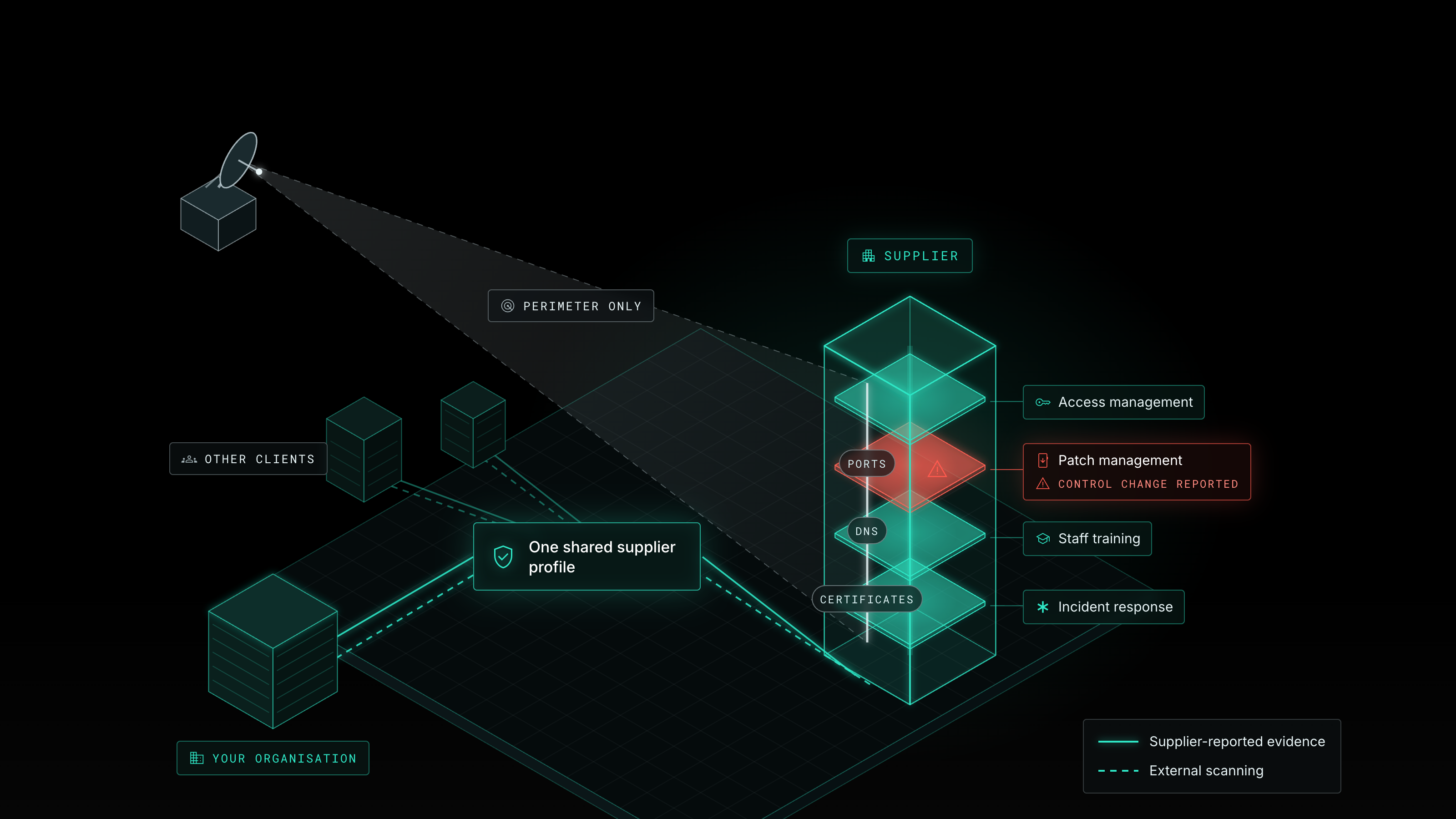
How we helpSuppliers keep one reusable security profile with supporting evidence and certifications, updated over time rather than re-collected for every customer.
The questionWhat sits behind our direct suppliers?
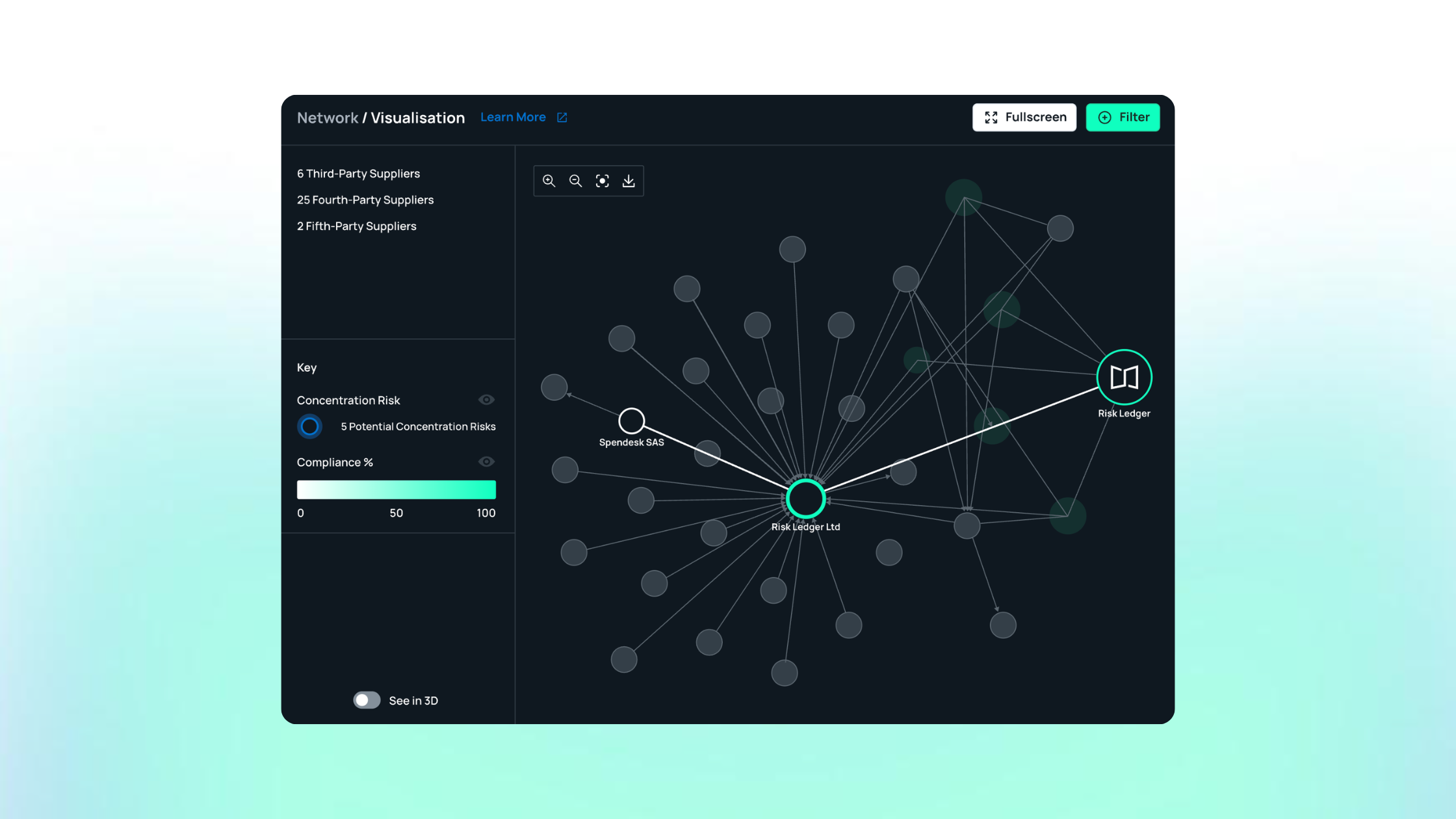
How we helpThe network view shows nth-party dependencies and concentration risk, meaning the suppliers many organisations rely on at once.
The questionDoes this incident affect our suppliers?
How we helpLive threat intelligence is applied to your supplier network, so you can see which suppliers are affected and where to act first.
The questionCan we show our reasoning to an auditor?
How we helpA record of reviews, evidence, risks, remediation and approvals, with reporting for internal governance and audit.
Where our role stops
We don't assess whether you are in scope, file reports to your regulator, or replace your incident process. Reusing a supplier's profile supports your risk decision. It doesn't make that decision for you.
Most of the problems in this guide come from the same place. Every organisation assesses its suppliers on its own, one questionnaire at a time, and the answers start ageing as soon as they arrive.
Our model works differently. Suppliers keep one security profile, with their evidence attached, and share it with each customer that connects to them. Those connections form a network, which shows something no single customer’s records can: which suppliers, and which of their suppliers, many organisations depend on at once. That is the concentration risk regulators now look for when they consider designating critical suppliers.
It means supplier evidence kept current, dependencies visible beyond your direct suppliers, and a shared response when an incident hits a supplier that many organisations use.
The model has a trade-off, and we’re open about it. A common assessment framework means slightly less freedom over the exact questions you ask. Haydn Brooks, our CEO, describes it to customers as “a five or 10% hit on the granularity of questions you can ask”. In return, you get a much broader data set across many more suppliers.
Reusing a supplier’s profile supports your judgement. It doesn’t replace it, and your organisation still owns the risk decision. The network view of dependencies is also a starting point. Check it against your own service and architecture records.
Is the Cyber Security and Resilience Bill law yet?
No. As at 16 October 2026, the Bill has completed its House of Commons stages and is in the House of Lords, with Report stage listed for 26 October 2026. It becomes law at Royal Assent, and most of its duties then follow through secondary legislation after consultation. Check the latest stage on bills.parliament.uk.
When will the Cyber Security and Resilience Bill come into force?
In phases after Royal Assent, which has no date yet. The future-proofing powers start on day one, and the statement of strategic priorities and information sharing rules follow in month two. The rest, including critical supplier designation, managed service provider and data centre duties and the new incident reporting, starts through secondary legislation, with an adjustment period before duties apply.
Does the Bill apply to public bodies?
Some public bodies are already regulated. NHS trusts and integrated care boards are operators of essential services, and data centres run by or for the Crown that meet the thresholds are within the new regime. Most councils, government departments and police forces are not regulated directly, but the managed service, cloud and data centre providers they rely on may be. The government intends to exclude public sector bodies from designation as critical suppliers.
Can a small supplier be designated as a critical supplier?
Yes. Small and micro managed service providers are excluded from the general managed service provider category, but a regulator can still designate them as critical suppliers if all four conditions are met. Size alone does not protect a supplier whose failure would significantly disrupt essential or digital services. Read the designation factsheet.
Can a designated supplier challenge the decision?
Yes. A regulator must consult the supplier before designating it, and the supplier can appeal the decision to the First-tier Tribunal. The duties a designated supplier carries will be set in secondary legislation, and they will be no stricter than those on the operators it supplies.
Does every cyber incident have to be reported within 24 hours?
No. The 24-hour initial notice applies only to regulated organisations, and only for incidents with a significant actual or likely impact in the UK. The thresholds for "significant" will be set in secondary legislation after consultation. A fuller report follows within 72 hours. Read the incident reporting factsheet.
What happens if our managed service provider has an incident?
If it is a regulated managed service provider, it reports significant incidents to the Information Commission. After its full report, it must identify customers likely to have been affected and notify them. If you are regulated yourself, your own full report must say whether another regulated organisation's incident caused yours.
Is the Cyber Security and Resilience Bill the same as the EU Cyber Resilience Act?
No. The EU Cyber Resilience Act is an EU product security law covering products with digital elements sold in the EU. The UK Bill regulates services and the organisations that run them. A UK manufacturer selling into the EU may need to consider both.
Does reusing another organisation's supplier assessment count as evidence?
It can support your judgement, but it does not replace it. The NCSC's Cyber Assessment Framework is clear that an organisation relying on third parties remains accountable for protecting its essential functions. Check that a reused assessment covers the service you actually use, and record your own risk decision.