October 16, 2026
・
25
mins read

Published 26 March 2024. Last updated 15 October 2026. [Risk Ledger / Continuous Monitoring in Cyber Security and TPRM]
Rebuilt with a definition-first structure, a comparison table, a step-by-step implementation guide, a comparison of monitoring methods, the WEF’s inheritance risk finding and the 2026 Verizon figures. Restored the reassessment and notification mechanics from the previous version.
A supplier assessed in January can look different by June. A new vulnerability, staff turnover, a missed patch or a change of subprocessor can shift a supplier’s risk, and the client may not find out until the next scheduled review.
The World Economic Forum’s Global Cybersecurity Outlook 2026 describes a related problem as inheritance risk: the inability to assure the integrity of third-party software, hardware and services. Its survey ranked it the top supply chain risk, and found that only 33% of organisations comprehensively map their supply chain ecosystems. Third-party involvement in breaches rose from 30% to 48% in Verizon’s 2026 Data Breach Investigations Report, which covers incidents from November 2024 to October 2025.
Most TPRM programmes handle change through the reassessment cycle. Continuous monitoring operates in the months between one review and the next. The term is sometimes applied to tools that only check a supplier’s public-facing infrastructure, which leaves its internal controls unobserved.
This guide sets out what continuous monitoring means for third-party risk specifically, starting with a working definition. It sits alongside our guides to what third-party risk management is and vendor risk management. For the regulatory picture in finance, see continuous monitoring in financial services.
Continuous monitoring in third-party risk management is the ongoing tracking of a supplier’s security controls, vulnerabilities and risk posture between formal assessments. It gives a client a current view of the supplier’s exposure, including control changes and new weaknesses, in place of a snapshot from the last review.
NIST defines information security continuous monitoring as maintaining ongoing awareness of information security, vulnerabilities and threats to support risk management decisions. Its note in SP 800-137 says “continuous” and “ongoing” mean that controls and risks are assessed and analysed at a frequency sufficient to support risk-based security decisions. That does not require real-time monitoring of every control at every supplier, and it allows frequency to follow criticality.
The tools usually associated with the term, such as SIEM, network detection and response, and endpoint detection and response, watch an organisation’s own systems. Third-party continuous monitoring covers a different environment, one the client does not control and cannot instrument directly.
Standards address supplier monitoring directly. NIST Cybersecurity Framework 2.0 includes supply chain risk management in its Govern function (category GV.SC), and NIST’s SP 1305 is a quick-start guide to cybersecurity supply chain risk management. ISO/IEC 27001:2022 Annex A control 5.22 is titled “Monitoring, review and change management of supplier services”.
Continuous monitoring is the practice that keeps supplier information current between reviews. The rest of this guide covers what it involves, how it compares with a standard point-in-time assessment, and how to build it into a working TPRM programme.
A continuous monitoring programme for third-party risk combines several distinct capabilities. Each does a different job, and a programme missing any one of them will have a blind spot.
None of these replace the underlying assessment work. They change how current that work stays once it’s done.
A point-in-time assessment tells a client what a supplier’s controls looked like on a specific date. Continuous monitoring tells a client what they look like now. The difference sounds small until you look at what each approach produces.
A formal review still produces detailed, context-rich evidence that a supplier cannot provide any other way, such as why a control exists and how it is applied. Continuous monitoring does not replace that review. It keeps the review’s findings current by flagging changes between assessments.
Verizon’s 2026 report found third-party involvement in 48% of breaches, up from 30%. That measures how often third parties are involved in breaches. It does not measure the effect of review frequency, but it shows why a client’s picture of its suppliers matters.
Continuous monitoring is built in stages, and skipping the early ones usually shows up later as noise, false confidence, or both.
Start from an accurate supplier inventory and criticality tiering. You can’t monitor what you haven’t identified, and not every supplier needs the same intensity of attention. A payroll provider handling employee bank details warrants a different level of scrutiny than a stationery supplier. Tiering keeps alert volume manageable by making sure the alerts that matter aren’t buried under ones that don’t. Our vendor risk management guide covers the wider process.
Define what triggers a reassessment outside the normal cycle. A disclosed vulnerability affecting software the supplier uses, an incident reported at the supplier itself, or a material change to its control environment should all be able to pull a supplier out of its scheduled review date and into an immediate one. If none of these can do that, the programme is still running on a fixed calendar in practice, whatever it’s called.
Choose a monitoring approach appropriate to each tier. Not every supplier needs the same combination of methods. A critical supplier might warrant supplier-reported evidence updates, external technical signals, and threat-intelligence overlays all at once. A low-tier supplier might only need the first. NIST’s definition ties frequency to what is sufficient for risk-based decisions, so different tiers can reasonably be monitored at different intensities.
Integrate monitoring output into existing remediation workflows. A flagged change is only useful if it reaches someone who owns the response and has a deadline attached to it. Without this step, monitoring data collects in a dashboard nobody checks, which is functionally identical to not monitoring at all.
Set internal escalation rules in advance. Decide, before an incident happens, who needs to know when a critical supplier’s posture changes materially, and how quickly. Working this out during an actual incident costs time you don’t have. Our supplier data breach response guide covers what happens when a supplier incident occurs.
These five steps build on each other. Skipping the tiering step means the trigger step has no basis for prioritisation. Skipping the escalation step means the other four produce information that arrives too late to act on.
No single method covers everything a continuous monitoring programme needs to see. Combining two or three approaches lets each compensate for what the others miss.
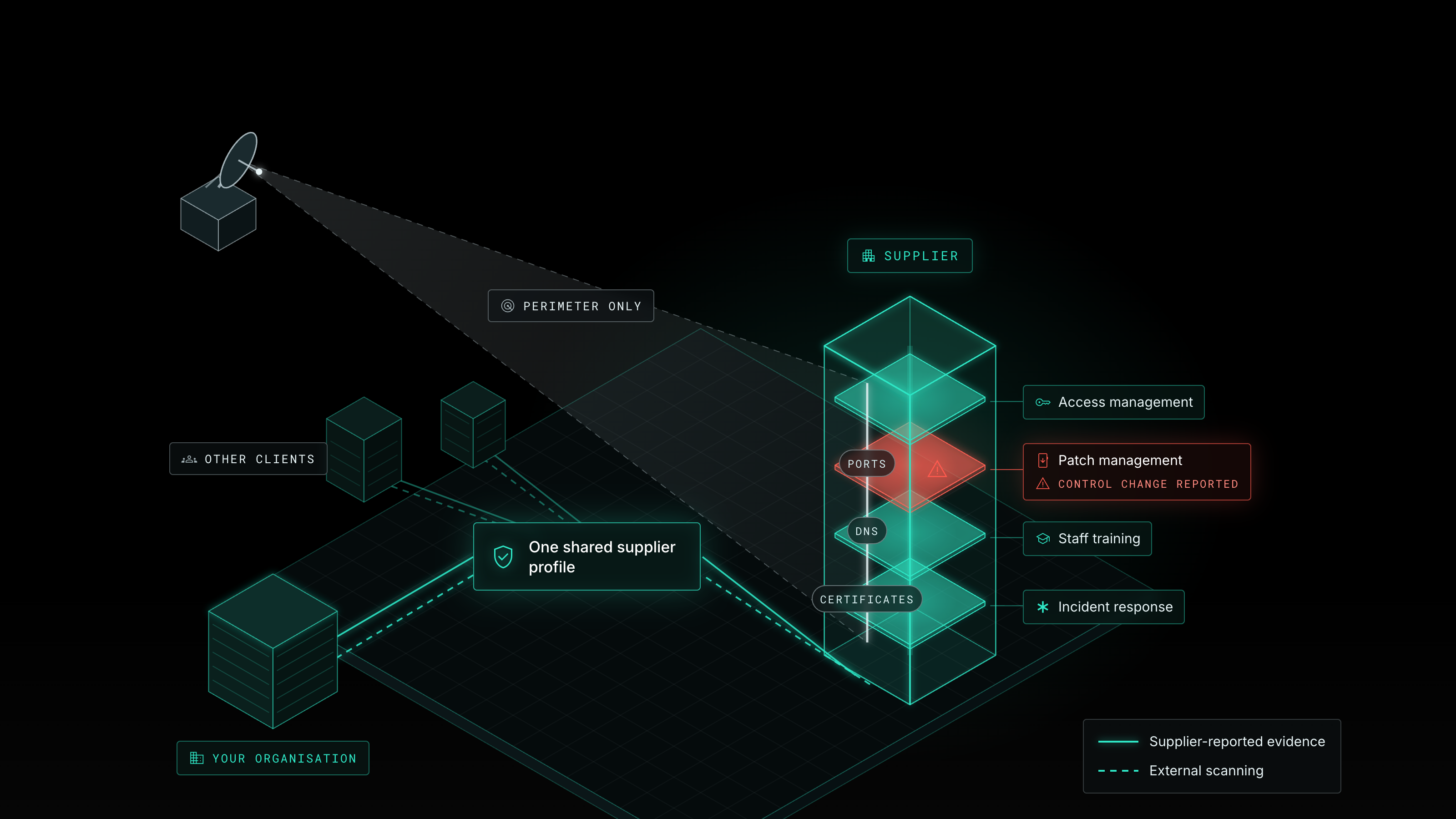
Supplier-reported evidence. A supplier updates its own profile as its control environment changes: a new certification, a patched vulnerability, a revised incident response plan. This is the only method that can capture internal detail such as staff training, access management, patch management practices and incident response capability. None of that is visible from outside. The trade-off is that it depends on the supplier actually reporting the change, and on that report being accurate.
External technical scanning. Automated tools can continuously check a supplier’s public-facing digital footprint: exposed ports, DNS configuration, certificate status, known vulnerabilities on internet-facing systems. This runs without needing the supplier to do anything, which is its main advantage. It’s also its main limit. Scanning sees the perimeter, not what’s behind it. It can flag a misconfigured server, but it can’t tell you whether the supplier trains its staff on phishing or tests its backups. Results can also include false positives that need manual review before they mean anything.
Threat-intelligence overlays. When a new vulnerability or attack technique emerges, mapping it against a known supplier network answers a specific question fast: are any of our suppliers affected? This method is built for speed during an active threat. It does not track gradual changes in a supplier’s posture. Risk Ledger publishes emerging threat notices on vulnerabilities and breaches with supply chain impact.
Treated as a single tool, each of these gives an incomplete picture. Treated as three inputs into one view (internal evidence, external signals, and live threat context), they cover most of what a client needs to know, and each one catches something the others would miss.
Monitoring becomes continuous through a structural difference in how supplier data is collected.
In a bilateral model, a supplier maintains a separate assessment for each client that asks for one. If the supplier’s controls change, that change only reaches a client once that client happens to run its next review. On a shared network, a supplier maintains one profile, built on a standardised assessment framework, and every connected client sees the same profile at the same time. When the supplier updates its evidence in response to one client’s questions, every other connected client sees that update too, without needing to prompt their own review to get it. Because the framework’s questions are mapped to standards such as ISO 27001 and NIST CSF, clients can read the same evidence against the frameworks they use (see what framework mapping is).
Risk Ledger asks suppliers to complete a full reassessment every six months, and they can start it four weeks before the deadline. Clients receive weekly updates on control changes across their supplier base, in line with their own policies, and an activity feed records every control change for the lifetime of the connection. Tracking every control at every supplier in real time is not realistic. A fixed cycle plus change updates gets closer to current information without trying to.
When a supplier’s control environment changes, connected clients are told automatically, rather than needing to check back on a schedule to find out. Combined with the reassessment cycle, this is what makes the underlying evidence continuous in practice: a scheduled minimum, plus updates triggered by events on top of it. Clients with overlapping supply chains review the same suppliers on the same framework, so a supplier can be prompted to update its profile by one client’s question and every connected client benefits. See how the platform works.
Supplier-reported evidence and external scanning answer different questions, and the strongest picture of a supplier’s posture comes from having both.
Risk Ledger gives suppliers free external scanning covering email, web, DNS and port security, including discovery of domains and subdomains, scanning of exposed services, and checks for misconfigurations and certificate issues. Suppliers can see their own attack surface and fix issues before a client raises them. It is a supplier-facing tool first: it exists to help suppliers improve their own security.
Whether a supplier shares that scanning data with its connected clients is the supplier’s own decision. It controls its own profile, in the same way it controls the rest of what it discloses, and for the same reason: the data is about its own infrastructure, and sharing it is a choice. In practice, most suppliers choose to share it, because it works in their favour as independent, externally observed confirmation of what they’re already telling their clients about their security.
Where a supplier has enabled this, a client sees two things side by side: what the supplier says about its own controls, and what’s independently observable from outside. Neither one replaces the other. Self-reported evidence carries context a scan can’t provide, such as why a control exists, how it’s applied and what compensating measures are in place. A scan can surface something a supplier didn’t think to report, or hasn’t got round to fixing yet. Together, they give a client more grounds for confidence than either source would on its own. Risk Ledger’s 2026 research makes the same distinction between external scanning and monitoring of internal controls.
Continuous monitoring for third-party risk is still maturing, and a few directions are becoming clear.
Monitoring tools and TPRM platforms are likely to integrate more closely over time, so that external signals and supplier-reported evidence sit in one view rather than two separate systems a security team has to reconcile manually. Correlation between the two is also likely to improve, connecting an external scan result to the specific internal control it relates to, rather than leaving a team to work out the link themselves.
Visibility is also likely to extend further down the supply chain. As more suppliers monitor their own suppliers on the same basis, monitoring that currently stops at the direct relationship should start to reach further into the dependencies behind it.
Regulators are moving the same way. In October 2025, New York’s financial regulator published guidance calling for “a proactive, risk-based, and continuously adaptive approach to third-party governance” from the firms it supervises. Our guide to continuous monitoring in financial services covers what DORA, the UK regime and New York’s rules say.
None of this describes a finished state. It is the direction the industry is moving in, and the capability does not yet exist everywhere it is needed.
What is continuous monitoring in cyber security?
Continuous monitoring is the practice of maintaining ongoing awareness of security posture, vulnerabilities and threats, rather than relying on periodic, scheduled checks. Applied generally, it covers an organisation’s own systems. Applied to third-party risk, it covers a supplier’s systems and controls instead, tracking whether they’ve changed since the last formal review.
How is continuous monitoring different from a point-in-time vendor assessment?
A point-in-time assessment reflects a supplier’s controls as they stood on the date of the review. Continuous monitoring tracks what happens after that date, including control changes, new vulnerabilities and incidents at the supplier, so a client isn’t relying solely on information that may be months out of date by the time it’s next reviewed.
Does continuous monitoring mean real-time monitoring?
No. NIST’s definition says “continuous” and “ongoing” mean that controls and risks are assessed and analysed at a frequency sufficient to support risk-based security decisions. For third-party risk, that frequency can differ by supplier criticality.
How often should supplier risk be reassessed?
There’s no single fixed answer, and it should depend on supplier criticality. What matters more than the frequency of the scheduled cycle is whether anything can trigger a reassessment outside it. A disclosed vulnerability, an incident or a material change to the supplier’s controls shouldn’t have to wait for the next date on the calendar. For example, Risk Ledger asks suppliers to complete a full reassessment every six months.
Can continuous monitoring replace security questionnaires?
No. Questionnaires and formal assessments produce detailed, contextual evidence, such as why a control exists and how it’s applied, that neither a scan nor an alert can capture. Continuous monitoring keeps that evidence current between reviews and does not replace the review itself.
What triggers an out-of-cycle supplier reassessment?
Common triggers include a disclosed vulnerability affecting software the supplier uses, a reported incident at the supplier, or a material change to its control environment, such as a new subprocessor, a change in certification status or a shift in how remote access is secured.
Does external vulnerability scanning count as continuous monitoring?
Partially. Scanning gives continuous visibility into a supplier’s public-facing infrastructure, but it can’t see internal controls such as staff training, patch management practices or incident response capability. Treated as one input among several, it’s useful. Treated as the whole picture, it’s incomplete.
What is “inheritance risk” in supply chain security?
Inheritance risk is the World Economic Forum’s term for the inability to assure the integrity of third-party software, hardware and services. Its Global Cybersecurity Outlook 2026 survey ranked it the top supply chain risk, ahead of limited visibility.
See how supplier profiles stay current on Risk Ledger


Monthly research, case studies and practical guides you won't find anywhere else.
Join thousands of security managers turning their TPRM programmes into success stories.